You don’t find your will to live, you build it 🧱
There's a finding in psychological research that's easy to read past the first time, because it sounds almost too tidy to be true. People who can find redemptive meaning in their own suffering, who can build a life story where the hard chapters lead somewhere rather than just happening to them, consistently show higher levels of mental health, wellbeing, and maturity than people who can't (McAdams & McLean, 2013). This isn't a self-help slogan. It's a measured, replicated finding in the psychology of identity.
Which raises an uncomfortable question if your life doesn't feel like it adds up to a neat story yet. If the detours, the false starts, the years that don't fit cleanly into a resume or an obvious origin story, still sit there unexplained, more like loose ends than evidence.
What if that gap isn't a personal failing? Specifically: what if you've been quietly assuming that the people whose lives look coherent got there by living a coherent life, in the right order, without the detours, and you got something wrong somewhere along the way that they didn't. That assumption is common, and it's wrong on the mechanism. Coherence isn't something a life either has or doesn't have based on how tidy the events were. It's something built afterward, out of whatever actually happened, including the parts that looked like nothing at the time. The pizza delivery job. The relationship that ended badly and taught you what you'd never accept again. The two years you spent doing something that has nothing to do with what you do now. None of that is evidence you went the wrong way. It's raw material nobody's shown you how to use yet.
That's the specific, workable part. This isn't about positive thinking, and it isn't about deciding retroactively that everything happens for a reason, as if the universe was running a plan you weren't told about. It's narrower and more useful than that. The research says the difference between people who feel like their life makes sense and people who don't isn't the events themselves. It's whether they've actually done the work of connecting them, on purpose, rather than leaving them sitting there as a pile of disconnected things that happened. That work is learnable. It's not a personality trait some people have and others don't.
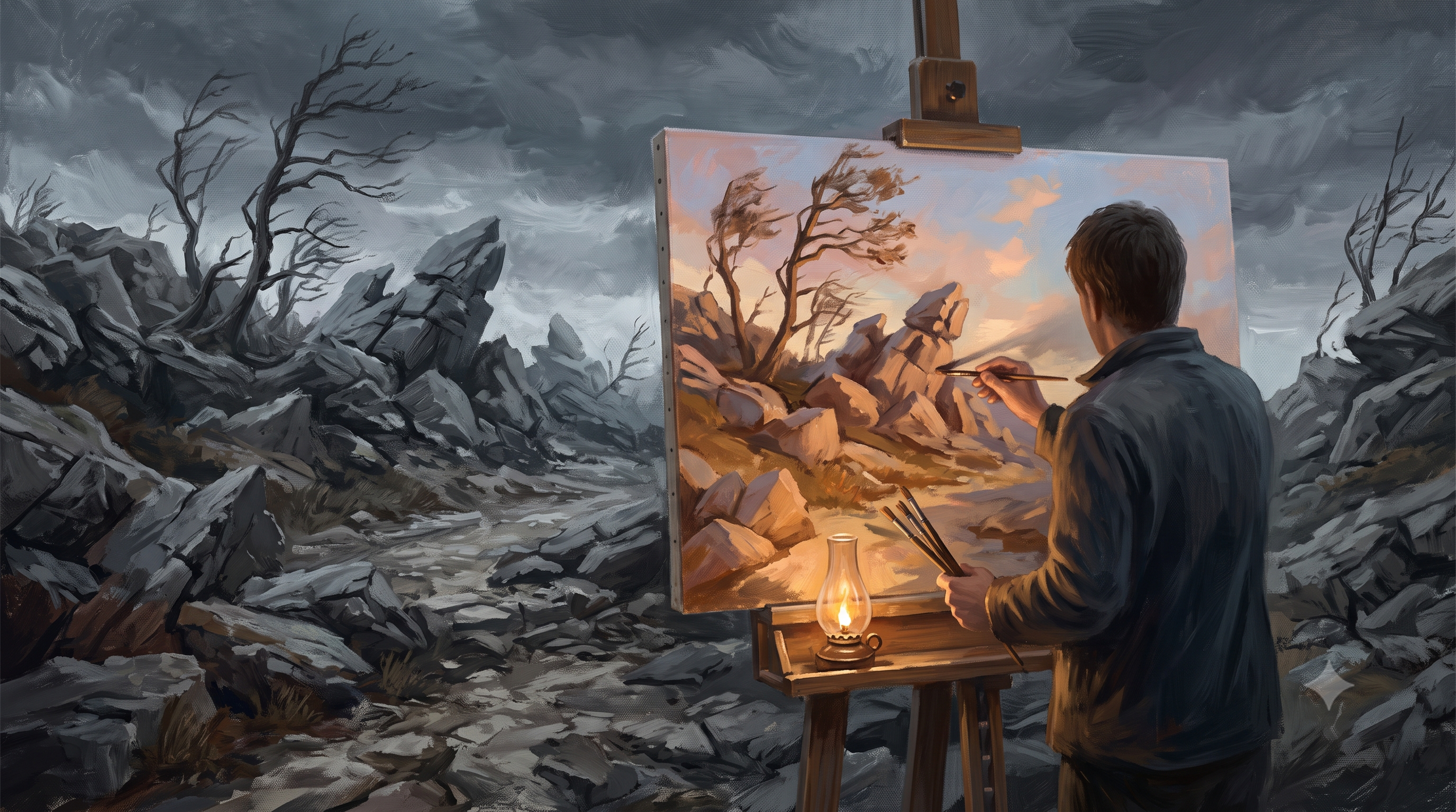
What The Research Says 👩🏽🔬
The researcher behind that finding is Dan McAdams, working with Kate McLean, and the framework they've spent decades building is called narrative identity theory. The basic claim is straightforward even if the implications run deep: people don't experience their lives as a list of things that happened. They experience them as a story, and the shape of that story matters more than most people realise (McAdams & McLean, 2013).
Within that story, two patterns matter most. A redemption sequence is a scene where something bad leads to something good, the negative moment isn't erased, but it's redeemed by what comes after. A contamination sequence runs the other way: something good curdles, and the negative bleeds backward until it overwhelms whatever came before it (McAdams & McLean, 2013).
Here's what that actually looks like, because the terms sound clinical until you see them in something ordinary. Two people lose a job in the same week, in the same kind of role. One of them tells the story like this: I got let go, it was brutal for about six months, and that gap is exactly why I ended up retraining in something I actually care about. The other tells it like this: I got let go, and ever since then nothing's quite worked, that's the year everything started going wrong. Same event. Completely different story shape. The first is a redemption sequence, the job loss gets folded into something that eventually paid off. The second is contamination, the job loss bleeds forward and starts explaining everything that came after it, whether or not it actually caused any of it.
It runs the other direction too. Someone has a genuinely happy childhood, and in hindsight reframes it as naive, as the reason they weren't prepared for how hard adulthood would be, the good years contaminated by what followed. Someone else had a rough one and tells it as the reason they learned to take care of themselves early, the hardship redeemed by what it built. Most people's lives contain both shapes running at once, plenty of redemption sequences and plenty of contamination sequences, often about events that, from the outside, look fairly similar in severity. What predicts wellbeing isn't avoiding the bad chapters or collecting more good ones. It's whether the story you've built around them tilts toward redemption or contamination, and that ratio is something you actually have some control over, even years after the events themselves are long finished.
Here's the part that answers the obvious objection. It would be easy to assume the causation runs the other way, that people who are already doing well simply tell happier stories about themselves. But a study tracking psychotherapy patients across at least a dozen sessions found something more specific: increases in personal agency within how patients narrated their own lives came first, and predicted improvement afterward, not the reverse (McAdams & McLean, 2013, citing Adler, 2012). The story isn't just a symptom of getting better. Changing it appears to be part of what gets you there.
The Wider Pattern 🌃
There's a name for this in the research, too, and it's worth knowing because it explains why the gap feels so personal even though it isn't. Habermas and Bluck (2000) call it the cultural concept of biography: the unspoken set of rules every culture carries about which events belong in a life story. Birth, school, career, partnership, the expected order of things. Deviate from that order and the deviation needs explaining. Stay inside it and no explanation is required.
This isn't unique to any one country or generation, though the specific shape of the template shifts. What stays constant is the mechanism: stories that match the cultural script get accepted without question, and stories that don't get quietly filed as needing a reason. The gap year. The career change at thirty-five. The decade that didn't look like anyone else's decade. None of it is wrong. It's just outside the template, which means the person living it ends up doing extra narrative labour that someone on-script never has to do.
This shows up even in clinical settings, where the stakes are higher. People recovering from serious mental illness often find themselves living inside someone else's story about what their life is allowed to become, a narrative of relapse and limitation that can persist regardless of how much they've actually recovered (Thomsen et al., 2025).
The template doesn't just describe a life. Left unexamined, it can start dictating one.
This is the part that's easy to miss because it doesn't feel like an external force, it feels like your own judgement. Thomsen, Cowan and McAdams describe how people recovering from serious mental illness often find themselves narrating their own future through a story that was handed to them rather than one they built, a script of relapse and limitation absorbed from the people and systems around them, regardless of how much they've actually recovered (2025). Nobody sits a person down and tells them this is the only story available. It seeps in sideways, through what gets emphasised in a hospital intake form, through which parts of a difficult year someone's family keeps bringing up, through which version of events gets repeated back often enough that it starts to feel like the only honest one. The same mechanism runs quieter outside clinical settings too. It's there when a parent describes a career change as “finally settling down,” as if the years before it were unsettled rather than simply different. It's there when “the bad year” becomes the only label a whole period of someone's life ever gets, long after that year stopped being the most accurate description of what happened in it. The template isn't usually imposed all at once. It accumulates in small repetitions until it sounds like the truth.
What Does This Actually Mean? 🧐
The connection is this: the reason your path feels like it needs explaining isn't a flaw in you. It's friction between your actual life and a template that was never built to fit it. The research says something more useful than “stop comparing yourself to others.” It says coherence doesn't come from matching the template. It comes from whether you can find meaning across both the difficult chapters and the good ones, not just survive the difficult ones and minimise them afterward.
This is where the data gets specific. Adults higher in what psychologists call ego development were more likely to narrate their hardest chapters as evidence that they'd genuinely changed through them, while adults lower in ego development tended to describe the same kind of scenes flatly, as things that happened rather than things that built anything (McAdams, 2001). The difference isn't whether something hard happened. It's whether the story you've built around it does any work.
Viktor Frankl put a version of this more starkly than any psychologist has. Writing from inside a concentration camp, he argued that nothing a person has actually lived through is ever truly lost. Once you've lived something, he wrote, it becomes irrevocably stored, not in the future, where it can still be taken from you, but in the past, where nothing can touch it again (Frankl, 2006). What you've been through doesn't disappear. It accumulates.
I've watched this play out from the inside of crisis work, not just as theory. In mental health triage, the people who stayed stuck the longest weren't always the ones with the worst circumstances. They were the ones who couldn't yet find a single thread connecting where they'd been to where they were going, whose story was still contamination all the way through, no redemption arc, no sense that any of it had built toward something. The shift, when it came, was rarely about the circumstances changing first. It was about the story changing first.
Ok, so… Now What? 🛟
Start by mapping both sides of the timeline, not just the hard one. Most people who do any kind of life review go straight for what went wrong, the breakup, the burnout, the year everything fell apart. The research suggests that's only half the work. Exploring a difficult chapter in depth, sitting with it long enough to actually understand it, is what builds psychological growth. But separately, consciously naming how it resolved or what it built is what's linked to actually feeling better, not just understanding yourself better (McAdams & McLean, 2013). They're not the same step, and most people stop after the first one. Write down five hard chapters and five good ones. Don't rank them against each other. Just get them on the page side by side, and notice which side you reached for first.
For each one, ask a more specific question than “what happened.” Ask “who did this make me.” People naturally integrate the different versions of themselves over time, the one from the job that nearly broke them, the one from the relationship that ended badly, the one from the year that fell apart, into a single coherent character rather than a pile of disconnected episodes (McAdams, 2001). You're not inventing this process. You're just doing it on purpose instead of waiting for it to happen on its own, which can take years, or never quite finish.
This works better with a witness, and it's worth being specific about why. When researchers studied how people tell stories about their lives, they found that an attentive, responsive listener, someone actually tracking what you're saying and asking real questions, causes the storyteller to include more detail, more nuance, and more of the parts that don't fit neatly (McAdams & McLean, 2013, citing Pasupathi & Hoyt, 2010). A distracted listener gets the short version, the one with the rough edges sanded off because nobody's really checking. An engaged one gets the version closer to what actually happened, including the parts you'd usually skip. And there's a second effect: when someone in your life agrees with how you've made sense of an event, you're more likely to hold onto that meaning over time, rather than losing it or talking yourself out of it later (McAdams & McLean, 2013, citing McLean & Pasupathi, 2011). So this isn't just about journalling alone, though that has real value too. It's about finding at least one person, a friend, a partner, a therapist, a guide, who'll actually listen while you do this, rather than doing the entire timeline in your head where nothing gets tested against anyone else's attention.
If a chapter you're mapping is closer to clinical-level trauma than ordinary difficulty, this isn't a substitute for professional support, and narrative-based approaches with real evidence behind them already exist inside the mental health system. Narrative exposure therapy is specifically designed for trauma, and narrative-integrated cognitive therapy combines this kind of identity work with more traditional psychological tools (Thomsen et al., 2025). A psychologist trained in either is worth asking for by name, rather than hoping a general intake session happens to cover it.
If you want to see this entire process done in writing, from inside the worst possible circumstances a person can face, Viktor Frankl's Man's Search for Meaning is the place to start. Frankl wasn't a writer looking for material. He was a practising psychiatrist in Vienna before the war, already developing his own approach to therapy, when he was sent to Auschwitz and then several other concentration camps, where his parents, his brother, and his wife all died. He wrote the book afterward, partly as an account of what he survived and partly as the foundation for the therapeutic method he'd go on to spend the rest of his career refining. As a clinician, he had a habit of asking patients in deep distress a blunt question: why haven't you ended your life yet. Not as a challenge, but because the answer, whatever it was, usually pointed to the thread of meaning the person was still holding onto, even if they couldn't see it themselves. That question, and the method built around it, came out of a man who'd already tested his own answer to it under the worst conditions imaginable, and decided meaning wasn't something you stumble onto. It's something you build, even in unthinkable conditions.
The Fires of Alchemy Connection 🔥
I'll tell you where this comes from for me, because I think it matters more than the theory does on its own.
I had suicidal ideation for most of my life, since I was a kid, long before I had language for what the feeling even was. I grew up somewhere that didn't make room for showing emotion, so I learned early to bury it and blame myself for having it in the first place. By the time I was working mental health crisis lines as an adult, I was burning out from the exact work I now build my life around, and the thoughts I'd been managing since childhood got loud enough that I was going to either act on them or actually fix something. I chose to try fixing something, mostly because I couldn't stand the thought of what it would do to the people who loved me.
I tried a lot of different things. Therapy gave me real tools, schema work in particular helped me understand my own patterns with precision. But understanding wasn't the same as healing. I could name exactly what was wrong and still feel nothing shift, because naming an emotion, even a specific one, is still analysis. It's still happening in the head. What I actually needed to learn was how to feel the emotions themselves, let them move rather than examine them from a safe distance, and for a long time I didn't know that was even safe to do.
For years I self-medicated with cannabis instead, legally, on prescription, and it did genuinely help me get through periods I'm not sure I would have survived otherwise. I don't regret that. But I also want to be direct about the rest of it: it's not something I'd recommend for anxiety or depression specifically, and while it isn't physically addictive in the way some substances are, it absolutely can become psychologically addictive, which is exactly what happened to me. I don't use it now, and I wouldn't suggest anyone start using it unless they're dealing with chronic pain that hasn't responded to other treatment. For a long time it let me avoid feeling things I wasn't ready to feel, which helped in the short term and quietly cost me time in the longer term.
The strange part of the story is that it also became my career for a few years. I went looking for work in medical cannabis partly because the substance already felt familiar to me, I understood it from the inside. I didn't know that at the time, I just took the job. But looking back, that move gave me years of clinical growth as a nurse and practitioner with genuine lived experience behind the knowledge, not just the textbook version. That's the “why it happened this way” for that whole chapter. I didn't go looking for a redemption sequence while I was living it. I built one afterward, out of exactly what had actually happened, including the part where my coping mechanism and my career briefly became the same thing.
What actually shifted everything, eventually, was changing the story itself, doing what the research above describes, except I didn't have the research at the time. I was just doing it because nothing else had fully worked. I started treating the worst parts of my life as material for telling a new story, rather than just damage I endured. The crisis line burnout, the years of self-blame, the cannabis use, even the suicidal ideation itself, I stopped trying to make any of it disappear and started asking what it had actually given me. The answer took a while to find, and it wasn't instant or obvious. It came out of a lot of trial and error: journalling, rebuilding community, finding a spiritual practice that fit me specifically rather than one I'd inherited. Eventually it became Fires of Alchemy, the blog, tarot readings, the soul mapping course, all of it. That's my personal answer to ‘why it happened this way’. I didn't find that answer waiting for me somewhere. I built it, slowly, out the material I already had.
Your answer won't look like mine, and it doesn't need to. You don't need to start a course or a blog. You need your own version of that same move: taking whatever you've actually lived through and asking what it was for, rather than asking why it happened to you. That's most of what Soul Mapping is built to help with, if you want a structured way to do it instead of working it out alone the way I did.
The Takeaway 👨🏻🎨
Here's what actually changes once you've done this. Your life stops being a list of things that happened to you, some good, some bad, sitting there unconnected. It becomes something you can read. The hard chapters aren't erased and the good ones aren't inflated, you're just finally looking at the shape the whole thing makes, on purpose, instead of by accident.
That shape isn't fixed. It's not a verdict on who you are. It's closer to a draft you've been writing your whole life without realising it, which means it's also something you can keep working on. Mapping both sides of your own timeline, the hard chapters and the good ones, side by side, is the place to actually start, today if you want.
If any of what you're mapping runs deeper than this kind of self-directed work can hold, that's worth taking to an actual therapist rather than carrying alone. Look specifically for someone trained in narrative therapy or narrative exposure therapy if trauma is part of what you're working through, or schema therapy if old patterns feel like they're running the show more than you'd like. Not every therapist works this way, and it's a completely reasonable thing to ask about directly when you're looking for one.
If you want a guided structure for the rest of it, that's exactly what the Soul Mapping course's Life Review work is built for, and it's a natural next step from here.
References 📚
Bruner, J. (1987). Life as narrative. Social Research, 54(1), 11–32.
Bruner, J. (1990). Acts of meaning. Harvard University Press.
Frankl, V. E. (2006). Man's search for meaning (I. Lasch, Trans.; 4th ed.). Beacon Press. (Original work published 1946).
Habermas, T., & Bluck, S. (2000). Getting a life: The emergence of the life story in adolescence. Psychological Bulletin, 126(5), 748–769. https://doi.org/10.1037/0033-2909.126.5.748
McAdams, D. P. (2001). The psychology of life stories. Review of General Psychology, 5(2), 100–122.
McAdams, D. P., & McLean, K. C. (2013). Narrative identity. Current Directions in Psychological Science, 22(3), 233–238. https://doi.org/10.1177/0963721413475622
Thomsen, D. K., Cowan, H. R., & McAdams, D. P. (2025). Mental illness and personal recovery: A narrative identity framework. Clinical Psychology Review, 116, 102546. https://doi.org/10.1016/j.cpr.2025.102546
Further Reading 📖
Adler, J. M. (2012). Living into the story: Agency and coherence in a longitudinal study of narrative identity development and mental health over the course of psychotherapy. Journal of Personality and Social Psychology, 102, 367–389.
Helson, R., & Roberts, B. (1994). Ego development and personality change in adulthood. Journal of Personality and Social Psychology, 66(5), 911–920.
McAdams, D. P. (2013). The redemptive self: Stories Americans live by (Rev. and expanded ed.). Oxford University Press.
McLean, K. C., & Pasupathi, M. (2011). Old, new, borrowed, blue? The emergence and retention of personal meaning in autobiographical storytelling. Journal of Personality, 79, 135–163.
Pasupathi, M., & Hoyt, T. (2010). Silence and the shaping of memory: How distracted listeners affect speakers' recall of a computer game experience. Memory, 18, 159–169.
Roe, D., Hasson-Ohayon, I., Mashiach-Eizenberg, M., Derhy, O., Lysaker, P. H., & Yanos, P. T. (2014). Narrative enhancement and cognitive therapy (NECT) effectiveness: A quasi-experimental study. Journal of Clinical Psychology, 70(4), 303–312.
